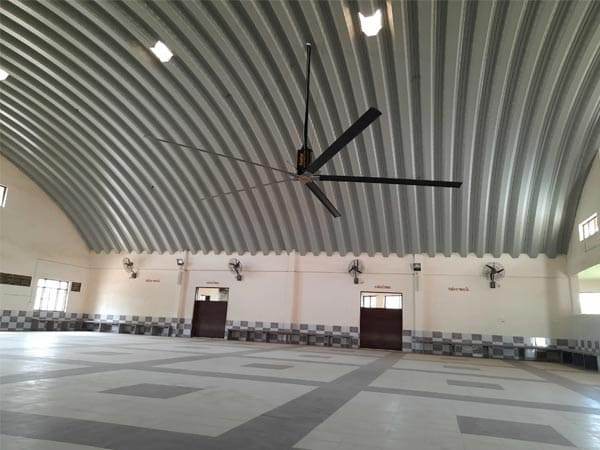
Start with roof height, not floor area
The single most common sizing mistake is dividing floor area by a coverage figure from a brochure. Coverage is a function of mounting height as much as diameter — the same 24 ft fan covers a much smaller circle at 18 ft than it does at 35 ft, because the column of air needs vertical distance to spread before it reaches the floor. Below 18 ft of roof height, expect the coverage circle to narrow sharply and the fan count to go up.
Then look at the shape of the floor plate
A square 20,000 sq.ft. building and a long narrow 20,000 sq.ft. building need different answers. In a long narrow bay, two 18 ft fans will usually beat one 24 ft fan, because coverage circles overlap along the length instead of leaving unserved corners. This is why we ask for a layout rather than just dimensions.
Account for obstructions before finalising
Crane girders, sprinkler lines, racking, lighting rigs and overhead conveying pipework all constrain where a fan can physically go. It is common for the first-pass layout to move by several metres once the obstruction drawing is overlaid, and occasionally the constraint changes the size selection entirely.
Optimise before you quote
The step most suppliers skip is optimisation — going back over the layout to see whether the same coverage can be achieved with one fan less. On a mid-sized shed this routinely takes one or two fans out of the count. It is a smaller order for us and a better outcome for the customer, which is why it is a standard step in our process.