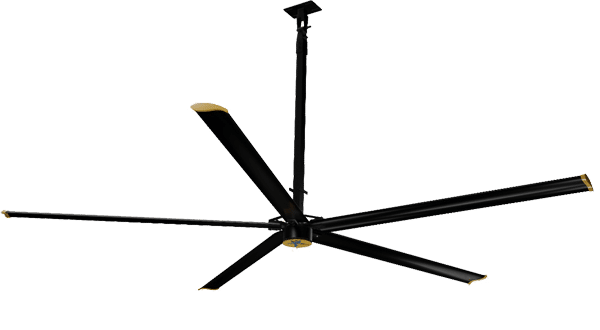
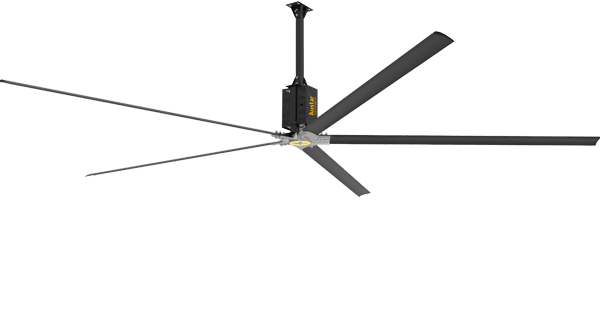
Gearless
Gearless 16 Feet HVLS Fan
- Diameter
- 16 ft
- Air Delivery
- 355,000 CFM
- Coverage
- up to 10,000 sq.ft.
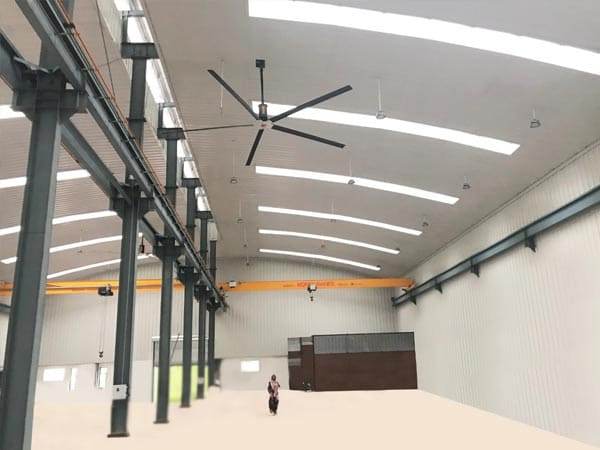
Packing halls are staffed densely and often run long shifts, but the hygiene requirement rules out pedestal fans blowing air horizontally across product at floor level. At the same time, still air makes the hall uncomfortable, and where the roof is uninsulated the temperature climbs steadily through the day. Any solution has to move air without creating a contamination path or a cleaning problem.
Ceiling mounted HVLS fans keep the equipment off the floor and out of the product zone entirely. Air moves downward in a broad, slow column and outward across the floor, which is a far more hygienic pattern than a high-velocity horizontal jet. The finish on both ranges is a hard protective coating that cleans down easily. Fans are positioned over circulation and staging areas rather than directly over open product lines.
Typical selections for this facility type. Final size and quantity come out of the feasibility study once we have your roof height and layout.
Gearless
Gearless
Geared
Not mandatory, but strongly preferred — a direct drive fan has no gear oil above the floor, which removes the question entirely for both food safety and pharma audits.
Yes, and they usually improve it. Even distribution of conditioned air means fewer hot spots and often allows a higher set point for the same comfort.
Blades and hub wipe down from an access platform at the scheduled interval. This is included in the annual maintenance visit.
Fan positions are planned to avoid open product zones. Layout is finalised with your quality team during the feasibility study.
Industry is pre-selected. Add your dimensions and we come back with a fan size, a quantity and a layout drawing.
Send us the basics and our team will respond within one working day.
Give us your shed bay by bay and we come back with a fan size, a quantity and a layout drawing — no charge, no obligation.
Measure each bay on its own — length, width, and roof height from the floor to the underside of the truss. Then take two or three photos looking straight up at the roof, so we can read the roof type and the hanging arrangement.