Made in Ahmedabad INDIA · Exporting worldwide
The Challenge

What Goes Wrong Without It

A workshop roof absorbs heat all day and radiates it down onto the floor, while machines, welding sets and compressors add their own load. Wall mounted air circulators only reach the operators standing directly in front of them, leaving dead zones between machines. The result is uneven cooling, fatigue by mid-shift, and a bank of small fans running continuously for very little effect.

The Austar Solution

How HVLS Fixes It

A small number of HVLS fans replaces the entire bank of circulators. Air is pushed down in a broad column from ceiling height, migrates outward across the floor and returns up the walls, so every operator position gets the same air movement instead of only the ones near a fan. The 4 – 5 degree wind chill effect makes a 38°C shop floor feel like 33°C, and destratification pulls the hot layer down from the roof so the whole volume equalises. Dust is not blasted around at high velocity the way a pedestal fan does it — the air moves slowly over a large area.

Recommended Models

What We Usually Specify Here

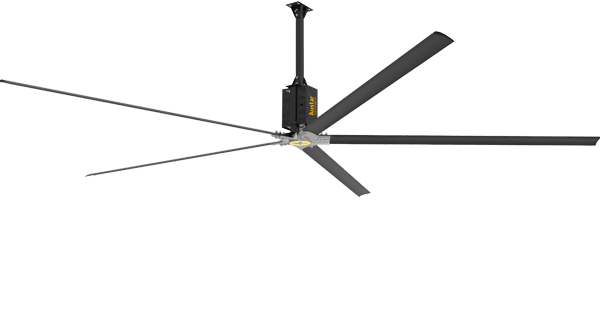
Typical selections for this facility type. Final size and quantity come out of the feasibility study once we have your roof height and layout.

At Site

Installation Considerations

  • Mounting height of 18 – 30 ft to the underside of the fan works best; below 18 ft the coverage circle shrinks sharply.
  • Fans are hung from the roof truss or purlin with an IS 2062 M.S. structure and SS wire rope safety wrapping.
  • Clearance of at least 600 mm from the blade tip to any beam, duct, light fitting or crane path.
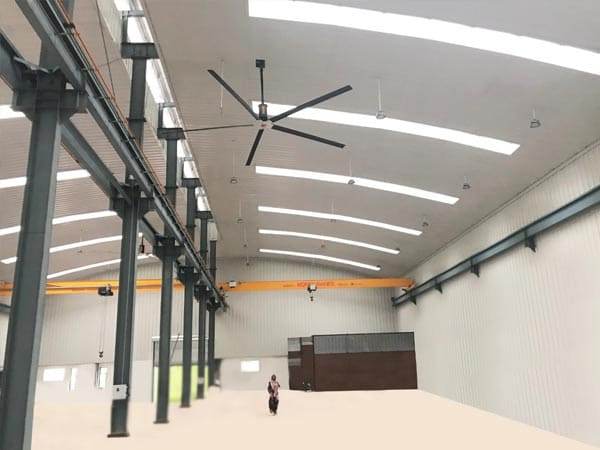
  • Where an EOT crane runs in the bay, fan positions are planned around the crane girder before finalising layout.
  • Single or three phase supply to the VFD panel, mounted at 4 – 5 ft floor level for operator access.
Industrial Workshops installation
Project Reference

Installed In The Field

See The Full Installation Gallery
Questions

Asked By Industrial Workshops

Yes, though most customers switch the wall fans off once the HVLS fans are commissioned. The usual pattern is that a 20 ft HVLS fan replaces roughly 20 – 25 wall mounted circulators in that zone, so the wall fans are kept only as backup.

HVLS fans move a large volume of air slowly, so velocity at floor level is gentle. For MIG and TIG stations we plan the layout so the fan is not directly overhead, and the VFD lets you drop the speed during shielded welding.

A 20 ft geared fan uses a 1.5 KW motor and typically runs well below rated load. Against 20 – 25 conventional fans at roughly 75 W each, running cost drops substantially — the ROI calculator will work out the figure for your tariff.

Geared fans need a gear oil change per the schedule and a fastener check at each service visit. Gearless models remove the oil change entirely. Both are covered under the annual maintenance contract.

All Frequently Asked Questions
Free Of Charge

Feasibility Study For Your Industrial Workshops

Industry is pre-selected. Add your dimensions and we come back with a fan size, a quantity and a layout drawing.

Two or three photos looking up at the roof, plus a layout drawing if you have one. This is how we read the roof type and the hanging arrangement.

Free of charge, no obligation. We reply within one working day.